In-House IT vs Managed Services for 50-Person Teams
A direct cost and risk evaluation of hiring in-house IT staff versus partnering with a Managed Service Provider for a 50-person enterprise: TCO and hybrid models.
Quick answer
What to know before reading further
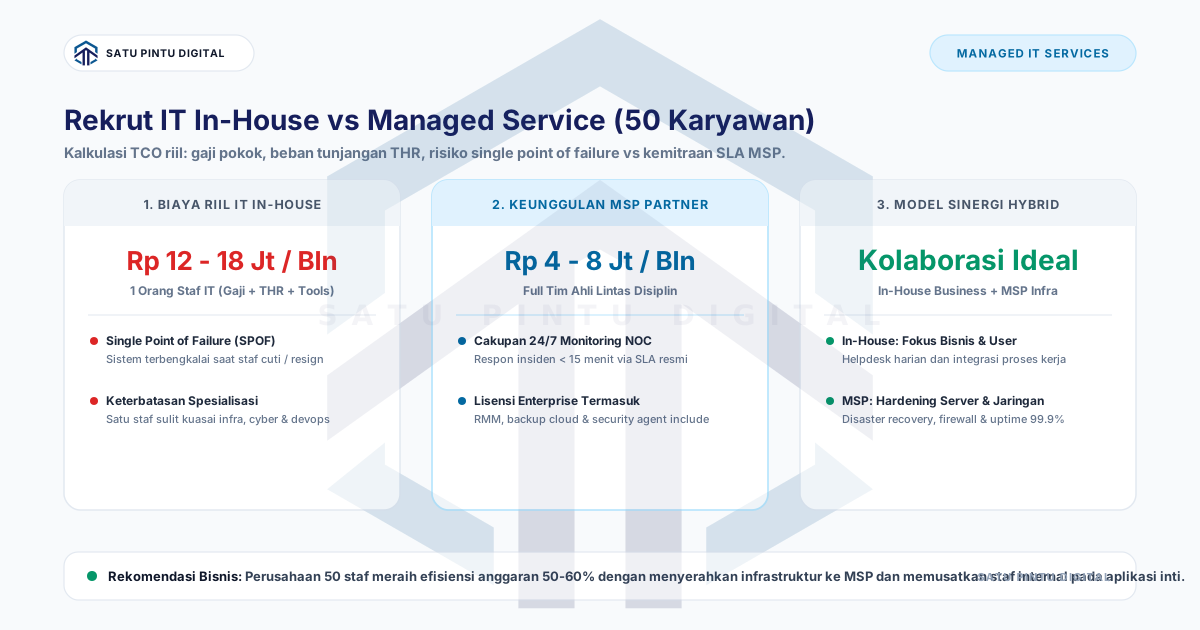
- For a 50-person organization, hiring a single internal IT engineer incurs fully loaded costs of $800–$1,400/month (base salary, mandatory benefits, hardware amortization, and software tool licensing) while introducing critical single-point-of-failure risks. Engaging a Managed Service Provider (MSP) requires $350–$600/month, delivering multidisciplinary coverage, 24/7 telemetry monitoring, and binding SLAs. A hybrid co-managed model offers the optimal balance for scaling businesses.
Process map
One examination, several checkpoints
- 01
Audit Internal Operational Workload and Helpdesk Demands
Map engineering hours spent on routine printer/desktop triage versus core server maintenance, network security, and backup oversight.
- 02
Calculate Fully Loaded Employee Labor Costs
Account for base salary, statutory holiday bonuses (THR), social insurance, workstation depreciation, and recruitment overhead.
- 03
Evaluate Single Point of Failure (SPOF) Fragility
Determine organizational exposure if the primary internal technician abruptly takes leave or departs the company without documentation.
- 04
Review Managed Service Provider Retainer Tiers
Assess contractual SLA coverage, 24/7/365 network operations center (NOC) monitoring, bundled security tools, and predictable monthly fees.
- 05
Deploy a Co-Managed Hybrid Delivery Model
Establish clean boundaries: internal personnel handle local user support while the MSP governs firewall perimeter and server uptime.
As an organization expands to 50 employees, technology infrastructure becomes the backbone of daily commercial operations. Network latency, unverified backup routines, or ERP server bottlenecks immediately disrupt the productivity of dozens of knowledge workers.
Leadership faces a strategic crossroad: Should the company hire a dedicated internal IT technician, or engage an external Managed Service Provider (MSP)?
This guide breaks down fully loaded employment costs, operational failure risks, and the most effective delivery models for scaling businesses.
The True Cost of In-House IT Staffing
Executive leadership frequently evaluates internal hiring solely by baseline monthly net salaries. However, true Loaded Labor Cost calculations must include statutory additions and operational overhead:
+-------------------------------------------------------------------------------+
|             MONTHLY FULLY LOADED COST PER INTERNAL IT ENGINEER                |
+-------------------------------------------------------------------------------+
|  Base Salary (Mid-Level Systems / Support Engineer) : $  650                  |
|  Statutory Holiday Bonus Proration (1/12 Monthly)   : $   55                  |
|  Employer Social Insurance & Health Contributions   : $   65                  |
|  Workstation Hardware & Diagnostic Tool Depreciation: $   45                  |
|  Software Tool Licenses (RMM, Endpoint Security)    : $   50                  |
|  Recruitment, Onboarding & Training Amortization    : $   45                  |
+-------------------------------------------------------------------------------+
|  TOTAL MONTHLY LOADED EMPLOYMENT COST (1 TECHNICIAN): $  910 / month          |
+-------------------------------------------------------------------------------+
If an organization attempts to provide full shift coverage by hiring two engineers, total monthly payroll overhead climbs to $1,800–$2,200 per month.
Head-to-Head Comparison: In-House vs Managed Service
Evaluate the operational trade-offs for a 50-person commercial organization:
| Evaluation Criteria | 1 Internal IT Hire | Managed Service Provider (MSP) |
|---|---|---|
| Total Monthly Spend | $900 – $1,200 / month | $350 – $600 / month |
| Service Availability Window | Standard office hours (8 hrs x 5 days) | 24/7/365 Continuous Network Operations Center |
| Technical Skill Depth | Generalist (Limited specialized scope) | Multidisciplinary Team (Network, Security, DBAs) |
| Staff Absence & Turnover Risk | High (SPOF - Leaves Company Uncovered) | Zero (Continuous team continuity backed by SLA) |
| Enterprise Tooling Licenses | Purchased separately by company | Included within managed service retainer |
| Accountability & Governance | Internal performance reviews | Legally binding SLA with financial guarantees |
3 Critical Risks of Single-Technician Dependency (SPOF)
Relying on a solitary internal technician introduces systemic fragility:
1. Single Point of Failure (SPOF)
When an infrastructure node crashes over a weekend or the primary technician takes personal leave, the organization lacks personnel with administrative root credentials, firewall knowledge, or recovery runbooks.
2. The Specialist Skill Gap
No single engineer possesses comprehensive depth across the modern IT spectrum: corporate routing/VLANs, Linux kernel hardening, relational database tuning, incident forensics, and physical hardware repair.
3. Knowledge Attrition During Turnover
When an internal technician departs, unwritten system architectural knowledge is lost. Successor onboarding requires 2 to 3 months of ramp-up time, leaving infrastructure unmonitored.
The Co-Managed Hybrid IT Model
For 50-person enterprises with an existing internal staff member, the optimal operational strategy is a Co-Managed Hybrid IT Architecture:
+-------------------------------------------------------------------------------+
|                         CO-MANAGED HYBRID IT ARCHITECTURE                     |
+-------------------------------------------------------------------------------+
|                                                                               |
|   [ INTERNAL IT STAFF ]               [ MANAGED SERVICE PARTNER (MSP) ]       |
|   - On-Site User Helpdesk              - 24/7 Infrastructure Telemetry & Alerts|
|   - Workstation & Peripheral Setup     - 3-2-1 Backup & Disaster Recovery      |
|   - Business Software Coordination     - Firewall Hardening & Perimeter Defense|
|   - Employee Onboarding & Triage       - Automated Scheduled Patch Deployments |
|                                                                               |
+-------------------------------------------------------------------------------+
This model removes after-hours emergency burdens from internal staff, enabling them to focus on high-impact business workflow digitization while the MSP partner guarantees infrastructure resilience.
Conclusion
For a 50-person company, building an isolated in-house infrastructure team creates high cost overhead and staffing fragility. Partnering with an experienced Managed Service Provider delivers enterprise-grade 24/7 protection while capturing 50% to 60% operational budget efficiencies.
Need Managed IT & Server Architecture Solutions?
Discuss your managed server, network monitoring, and firewall needs for enterprise infrastructure.
Key terms
Quick glossary
- Loaded Labor Cost
- The total expenditure required to employ an individual, encompassing gross salary, statutory benefits, payroll taxes, equipment, and training.
- Single Point of Failure (SPOF)
- A single component, process, or individual whose disruption or absence precipitates a total operational breakdown across the system.
- Service Level Agreement (SLA)
- A formal contract defining specific operational performance metrics, maximum response times, and financial remedies between a client and service provider.
- Co-Managed IT Model
- A collaborative operating framework where an organization pairs internal IT personnel with an external MSP to distribute responsibilities.
Read the sources
References and documentation
Frequently asked
Questions teams ask before implementation
- When does an organization genuinely require full-time internal software engineering staff?
- An enterprise requires dedicated internal software engineering personnel when developing proprietary software or digital products represents the organization's core commercial value proposition requiring continuous daily codebase iterations.
- Does partnering with a Managed Service Provider necessitate replacing existing IT staff?
- No. The most effective enterprise structure is a Co-Managed Hybrid model: internal staff are relieved of after-hours emergency triage and routine patching, allowing them to focus on business automation and user enablement.
- How is company intellectual property and data confidentiality safeguarded when working with an MSP?
- Professional MSP partnerships are governed by binding Non-Disclosure Agreements (NDAs), encrypted session audit logs, principle-of-least-privilege access, and contractual liability clauses.
Feedback
Did this guide help you understand Managed IT Services?
This article is part of Satu Pintu Digital's field notes. The next article covers a related topic.
Keep reading