Annual Corporate IT Security Audit Checklist
Comprehensive annual corporate IT security audit checklist: hardware asset inventory, IAM access controls, firewall perimeter audits, and disaster drill SOPs.
Quick answer
What to know before reading further
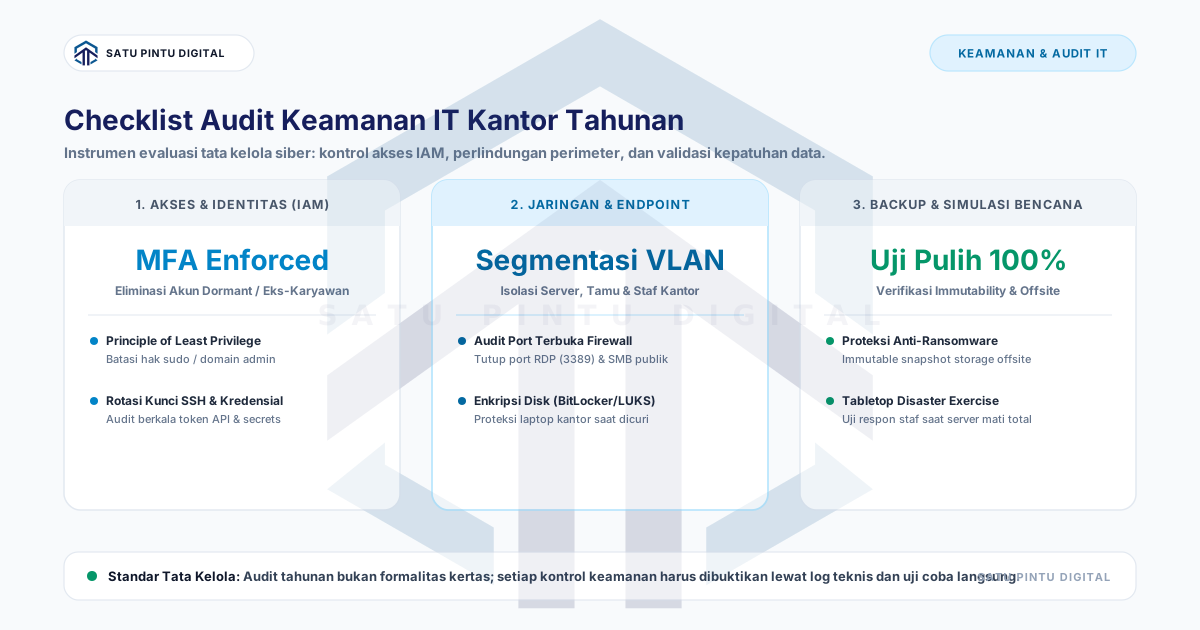
- An annual enterprise IT security audit evaluates 5 fundamental pillars: 1) Hardware and software asset inventories; 2) Identity & Access Management (enforcing MFA, revoking departed employee accounts, least-privilege roles); 3) Network perimeter defense (closing high-risk firewall ports, VLAN isolation, WPA3 enterprise Wi-Fi); 4) Endpoint and storage protection (full-disk encryption, 3-2-1 immutable backups); and 5) Incident response governance and live database restoration drills.
Process map
One examination, several checkpoints
- 01
Catalog Complete Digital and Physical Asset Inventory
Document all corporate servers, laptops, managed switches, routers, wireless access points, and active SaaS subscriptions.
- 02
Audit Identity Governance and User Access Rights (IAM)
Reconcile active HR employee rosters against email accounts, VPN profiles, SSH keys, and database administrative roles.
- 03
Execute Network Port Scans and Review Firewall Rules
Run external vulnerability scans to confirm high-risk administrative ports (such as RDP 3389 or SMB 445) are blocked from the internet.
- 04
Verify Storage Encryption and Backup Immutability
Confirm full-disk encryption across 100% of corporate laptops and execute sample data restoration from the 3-2-1 backup repository.
- 05
Compile Audit Findings and Remediation Roadmap
Categorize discovered vulnerabilities by CVSS risk tier (Critical, High, Medium) and establish binding remediation SLAs.
Many commercial organizations assume their internal IT infrastructure is secure simply because they have not yet experienced a publicized security incident. In an era of automated ransomware incursions and strict data privacy regulations, passive assumptions represent an unacceptable operational risk.
Conducting a disciplined Annual Corporate IT Security Audit enables executive leadership to identify and remediate infrastructure vulnerabilities before external adversaries exploit them.
The 5 Pillars of Enterprise IT Security Auditing
Utilize this structured framework to assess organizational security posture:
+-------------------------------------------------------------------------------+
|                    5 PILLARS OF ANNUAL CORPORATE IT AUDITING                  |
+-------------------------------------------------------------------------------+
|  1. ASSET HYGIENE     : Hardware catalog, software licensing, automated patch |
|  2. IDENTITY & ACCESS : Enforced MFA, offboarding audit, least-privilege roles|
|  3. NETWORK PERIMETER : VLAN isolation, firewall ingress audit, WPA3 Wi-Fi    |
|  4. ENDPOINT & DATA   : BitLocker/LUKS encryption, EDR agents, 3-2-1 backups  |
|  5. GOVERNANCE & DR   : Incident response runbooks, restore drills, awareness |
+-------------------------------------------------------------------------------+
Technical Audit Checklist Worksheet
Pillar 1: Asset Management & Patching Hygiene
- 100% of corporate servers, workstations, managed switches, and access points are tracked by serial number and MAC address.
- No End-of-Life (EoL) operating systems or unsupported software packages reside on the production network.
- Automated security patch pipelines deploy operating system updates during scheduled off-hours maintenance windows.
Pillar 2: Identity & Access Management (IAM)
- MFA Enforcement: 100% of corporate email accounts, VPN endpoints, and cloud dashboards require authenticator-app-based MFA.
- Dormant Account Revocation: All accounts belonging to departed employees or terminated contractors are revoked within 24 hours.
- Least Privilege: Domain administrative access and
sudoroot privileges are restricted strictly to designated technical personnel. - Credential Rotation: Internal API tokens, integration keys, and database administrative passwords undergo scheduled rotation.
Pillar 3: Network Perimeter & Wireless Security
- Port Ingress Audit: High-risk administrative ports including RDP (
3389), SMB (445), and Telnet (23) are completely blocked from public ingress. - VLAN Segmentation: Network traffic is isolated into distinct broadcast domains: Production Servers, Corporate Workstations, and Guest Wi-Fi.
- Wireless Infrastructure: Office Wi-Fi networks utilize WPA3-Enterprise or WPA2-Enterprise with client isolation enabled.
Pillar 4: Endpoint Security & Data Protection
- Full-Disk Encryption: 100% of corporate laptops enforce BitLocker (Windows), FileVault (Mac), or LUKS (Linux) encryption.
- Centralized EDR Protection: Standardized endpoint detection and response (EDR) agents maintain continuous threat signature telemetry.
- The 3-2-1 Backup Topology: Three data copies reside across two distinct physical media, with one offsite copy secured by Immutable Object Lock.
Pillar 5: Business Continuity & Governance
- Restoration Verification: Technical staff have successfully restored database and file structures from backup storage within the past 90 days.
- Incident Response Runbook: A written incident escalation plan defines roles, communication protocols, and containment procedures.
- Security Awareness Training: All personnel have completed annual phishing simulations and credential hygiene training.
Vulnerability Remediation Priority Matrix
Following audit completion, categorize findings into a structured remediation timeline:
| Risk Classification | Example Audit Finding | Remediation SLA |
|---|---|---|
| Critical | RDP port open to the public internet, unencrypted backup repositories | Remediate < 24 Hours |
| High | Former employee accounts remain active, executive email lacks MFA | Remediate < 72 Hours |
| Medium | Staff laptops missing disk encryption, guest Wi-Fi lacks client isolation | Remediate < 14 Days |
| Low | Outdated network topology diagrams, minor logging documentation gaps | Remediate < 30 Days |
Conclusion
An annual IT security audit is not an administrative checkbox; it is a fundamental governance mechanism designed to preserve enterprise operational continuity. Identifying infrastructure vulnerabilities internally is exponentially more cost-effective than managing the financial and reputational aftermath of a data breach.
Need Managed IT & Server Architecture Solutions?
Discuss your managed server, network monitoring, and firewall needs for enterprise infrastructure.
Key terms
Quick glossary
- Identity and Access Management (IAM)
- A framework of business processes, policies, and technologies that facilitates the management of electronic or digital identities.
- Multi-Factor Authentication (MFA)
- An electronic authentication method requiring a user to present two or more independent factors of identity verification before gaining access.
- VLAN (Virtual Local Area Network)
- A custom network created from one or more existing physical local area networks to isolate traffic and enhance organizational security.
- Principle of Least Privilege (PoLP)
- An information security concept requiring that users, programs, and systems are granted only the minimum access rights needed to perform duties.
Read the sources
References and documentation
Frequently asked
Questions teams ask before implementation
- How frequently should an organization conduct internal IT security audits?
- A comprehensive institutional audit should occur annually. However, user identity reviews (IAM) and external network vulnerability scans should be scheduled quarterly to capture emerging configuration drifts.
- What are the most frequent security vulnerabilities identified in mid-sized enterprise offices?
- Common vulnerabilities include: default device passwords on networking hardware, lack of MFA on corporate email, exposed Windows RDP ports facing the public internet, unencrypted laptop storage drives, and untested backup archives.
- Is an annual IT security audit mandatory under modern data privacy regulations?
- Yes. Global data privacy frameworks and national privacy laws mandate that data controllers enforce technical and organizational safeguards, data encryption, and verifiable incident mitigation measures under threat of severe financial penalties.
Feedback
Did this guide help you understand IT Security & Audit?
This article is part of Satu Pintu Digital's field notes. The next article covers a related topic.
Keep reading