Radiology Disaster Recovery & DICOM Backup SOP
Hospital radiology disaster recovery and DICOM backup standard operating procedures: 3-2-1 backup architecture, RTO/RPO benchmarks, and restore validation.
Quick answer
What to know before reading further
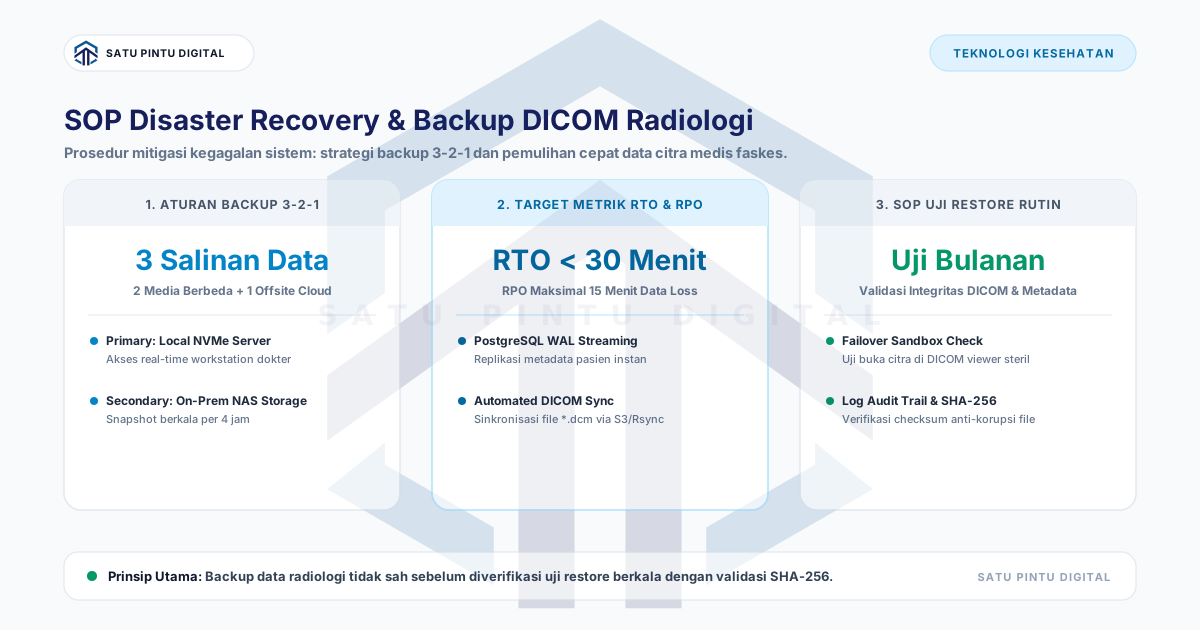
- Healthcare radiology disaster recovery requires a strict 3-2-1 backup architecture: 3 copies of imaging data (1 primary copy on local NVMe server storage, 1 secondary copy on a dedicated local NAS, and 1 immutable copy on offsite cloud object storage). Clinical targets mandate an RTO under 30 minutes and an RPO under 15 minutes, supported by monthly sandbox restoration drills.
Process map
One examination, several checkpoints
- 01
Segment Diagnostic Object Storage from Relational Metadata
Separate bulk binary *.dcm files from the transactional relational database (PostgreSQL / MySQL) containing patient records.
- 02
Implement Automated PostgreSQL WAL Streaming and NAS Snapshots
Configure point-in-time database transaction logs every 15 minutes and local NAS storage snapshots every 4 hours.
- 03
Replicate Encrypted Payloads to Immutable Cloud Storage
Stream new studies to an encrypted AWS S3 bucket with Object Lock compliance mode enabled to prevent modification.
- 04
Execute Monthly Sandbox Restoration Drills
Restore database tables and a 100-study DICOM batch onto an isolated verification node to ensure diagnostic fidelity.
- 05
Document Compliance Logs and Cryptographic Checksums
Record actual restore durations and SHA-256 validation logs for clinical accreditation and audit governance.
Hardware degradation, storage controller corruption, and ransomware incursions pose immediate threats to hospital radiology infrastructure. The loss or inaccessibility of diagnostic DICOM archives compromises emergency clinical workflows and violates statutory medical record retention obligations.
This operational guide outlines the Standard Operating Procedure (SOP) and technical architecture required to execute a verified Disaster Recovery (DR) program for healthcare PACS environments.
The 3-2-1 Medical Imaging Backup Architecture
A production PACS infrastructure consists of two distinct data tiers with different IOPS and retention profiles:
- Transactional Metadata Tier: Relational databases (PostgreSQL or MySQL) tracking patient demographics, study UID mappings, study statuses, and diagnostic reports.
- Bulk Diagnostic Object Tier: Raw binary
*.dcmfiles scaling from 10 MB (single X-ray) to 2 GB (multiphase CT or MRI slices).
+-------------------------------------------------------------------------------+
|                    HEALTHCARE RADIOLOGY 3-2-1 BACKUP TOPOLOGY                 |
+-------------------------------------------------------------------------------+
|                                                                               |
|  [ Imaging Modalities: DR / CT / MRI / US ]                                   |
|                      |                                                        |
|                      v                                                        |
|  +---------------------------------------+                                    |
|  | 1. Primary Live PACS (NVMe Storage)   | ---- (Zero-latency Diagnostic Tier)|
|  +---------------------------------------+                                    |
|                      |                                                        |
|           (Rsync / Snapshots / 4-hr)                                          |
|                      v                                                        |
|  +---------------------------------------+                                    |
|  | 2. On-Premises Isolated NAS Device    | ---- (Secondary Local Network Tier)|
|  +---------------------------------------+                                    |
|                      |                                                        |
|         (TLS 1.3 / S3 WORM Object Lock)                                       |
|                      v                                                        |
|  +---------------------------------------+                                    |
|  | 3. Cloud S3 Immutable Archive Vault   | ---- (Offsite Anti-Ransomware Tier)|
|  +---------------------------------------+                                    |
|                                                                               |
+-------------------------------------------------------------------------------+
The 3 Mandatory Data Copies:
- Copy 1 (Primary): Active production storage (NVMe SSD RAID 10) supporting sub-second retrieval for on-duty clinical workstations.
- Copy 2 (Secondary Local): Dedicated Network Attached Storage (NAS) located in a separate telecommunications closet on an isolated VLAN.
- Copy 3 (Offsite Immutable): Geographically distributed cloud object storage configured with compliance-grade Object Lock.
Recovery Metrics: RTO and RPO Benchmarks
Clinical informatics teams must enforce quantified recovery targets:
| Parameter | Clinical Benchmark | Operational Definition |
|---|---|---|
| Recovery Time Objective (RTO) | < 30 Minutes | Maximum allowable duration to restore full diagnostic PACS availability after complete primary node failure. |
| Recovery Point Objective (RPO) | < 15 Minutes | Maximum allowable data loss window for newly acquired studies prior to the disruption. |
Technical SOP: Database and File Store Automation
1. PostgreSQL Relational Metadata Backup Script
Deploy an automated database dump script executed via systemd timers or cron, backed by continuous Write-Ahead Log (WAL) archiving:
#!/usr/bin/env bash
# /opt/scripts/backup-pacs-db.sh
set -euo pipefail

BACKUP_DIR="/mnt/nas-backup/pacs-db"
TIMESTAMP=$(date +%Y%m%d_%H%M%S)
DB_NAME="pacs_production"
TARGET_FILE="${BACKUP_DIR}/db_${DB_NAME}_${TIMESTAMP}.sql.gz"

mkdir -p "${BACKUP_DIR}"

# Execute PostgreSQL database dump with maximum gzip compression
pg_dump -U postgres -h 127.0.0.1 "${DB_NAME}" | gzip -9 > "${TARGET_FILE}"

# Enforce local retention: prune backup archives older than 30 days
find "${BACKUP_DIR}" -type f -name "*.sql.gz" -mtime +30 -delete

echo "[$(date)] PACS PostgreSQL backup completed successfully: ${TARGET_FILE}"
2. Binary DICOM Synchronization to Immutable Cloud Storage
Synchronize diagnostic blobs using encrypted block streams and server-side encryption:
#!/usr/bin/env bash
# /opt/scripts/sync-dicom-cloud.sh
set -euo pipefail

SOURCE_DIR="/var/lib/orthanc/db/pacs-storage"
S3_BUCKET="s3://hospital-pacs-archive-vault/dicom-data"

# Synchronize DICOM objects to S3 bucket with AES256 server-side encryption
aws s3 sync "${SOURCE_DIR}" "${S3_BUCKET}" \
    --sse AES256 \
    --storage-class STANDARD_IA \
    --no-progress

echo "[$(date)] DICOM cloud archive sync completed successfully."
Monthly Restore Verification Drill SOP
Backups without routine restore verification introduce systemic vulnerability. Informatics staff must execute the following protocol monthly:
[ ] 1. Provision an isolated testing sandbox node (segregated from production DICOM traffic).
[ ] 2. Pull the latest PostgreSQL compressed dump file from the local backup NAS.
[ ] 3. Run `gunzip -c db_backup.sql.gz | psql -U postgres -d pacs_sandbox`.
[ ] 4. Retrieve a randomized 50-study sample of *.dcm directories from the offsite S3 vault.
[ ] 5. Access the sandbox web viewer and query sample studies via Patient ID and Accession Number.
[ ] 6. Validate windowing presets, multiplanar reconstruction (MPR), and sign-off report fidelity.
[ ] 7. Document actual recovery duration and SHA-256 verification hashes in the compliance ledger.
Conclusion
Operational resilience in clinical radiology demands a disciplined disaster recovery posture. By implementing the 3-2-1 backup topology, securing offsite archives with immutable WORM locks, and verifying restore procedures monthly, healthcare providers safeguard clinical continuity and regulatory compliance.
Need Assistance with SATUSEHAT & PACS Integration?
Consult your PACS architecture, smart DICOM router, and SATUSEHAT compliance with our engineering team.
Key terms
Quick glossary
- Recovery Time Objective (RTO)
- The maximum acceptable duration of system downtime permitted to restore normal diagnostic radiology operations following a failure.
- Recovery Point Objective (RPO)
- The maximum acceptable timeframe of potential data loss measured from the moment of an outage back to the most recent backup point.
- Write Once Read Many (WORM)
- A data storage security property where saved files cannot be altered, overwritten, or erased by any user until a defined retention expires.
- Write-Ahead Logging (WAL)
- A database transaction logging mechanism where changes are recorded sequentially before being written to persistent table storage.
Read the sources
References and documentation
Frequently asked
Questions teams ask before implementation
- How long are healthcare institutions legally required to retain radiology archives?
- Healthcare regulations require retaining patient medical records and diagnostic imaging files for a minimum of 5 years for outpatient encounters, extending up to 10 to 25 years for pediatric cases and specialized surgical interventions.
- Why is copying raw DICOM files alone insufficient for PACS disaster recovery?
- Raw DICOM files contain binary image pixel data and header tags, but lack the relational database schema tracking patient identifiers, accession numbers, billing statuses, and verified diagnostic text reports required for structured search.
- How can clinical facilities protect PACS repositories against ransomware?
- Deploy offsite cloud object storage with S3 Object Lock in compliance mode, enforce least-privilege API tokens, and eliminate persistent write access from local network endpoints to the backup vault.
Feedback
Did this guide help you understand DICOM routing and integration?
Transmit Radiology to SATUSEHAT Without the Setup Hassle
Connect your clinical imaging workflow—from modality worklists and automated accession numbers to web DICOM viewing and SATUSEHAT synchronization. Free Tier available for clinics and hospitals.
Keep reading